Collective Intelligence for Environmental Management
In an era where environmental threats are rapidly increasing, conservation technology has become indispensable for ensuring the survival of nature and the human communities that depend on it. Technologies such as remote sensing, spatio-temporal mapping, acoustic monitoring and e-DNA are at the forefront of this effort, providing critical data and insights for effective ecosystem management.
At The SEA People we aim to maximize the efficiency and effectiveness of our conservation efforts, and one of the key strategies we employ to achieve this is the use of conservation technology.
TECHNOLOGY AND REMOTE AREAS
Challenges in Data Collection & Management
DATA COLLECTION
In a vast area like Raja Ampat Marine Park, which spans over 2 million hectares of remote archipelago containing the most biodiverse coral reefs on Earth, effective management requires the collection and analysis of extensive environmental and socio-economic data. To obtain such data is a challenging effort in itself, and to go on to process, analyze, interpret and share this data, even more so. This often results in knowledge gaps, poor planning, and/or delayed and inadequate responses to environmental issues and management decision making.
TECHNOLOGICAL COMPLEXITY IN DATA COLLECTION
One of the significant challenges in data collection is the technological complexity involved. Often, the advanced tools and systems required for effective data gathering and analysis are not readily available in remote areas, nor are the skills and expertise required to use them.
ACCESSIBILITY AND INCLUSIVITY FOR REMOTE AND INDIGENOUS COMMUNITIES
Technological complexity results in a barrier between the data collection process and the local community’s ability to gather and interpret critical environmental data over the long term, increasing reliance upon costly ‘helicopter science/research’ (where a specialised team spends a short period of time in field, and gathers data from that specific point in time (only), to make long term, strategic plans), which ultimately impacts the effectiveness and sustainability of long term conservation efforts.
DATA ANALYSIS
Compiling, analyzing, and interpreting large datasets is cumbersome and time-consuming. This slow process can hinder timely environmental management responses and result in wasted resources and project instability or unsustainability.
DATA SHARING
Sharing data with management bodies, partners, funders, and donors can be a cumbersome and resource intensive process. The absence of reliable technological solutions, for both data in and results out, can lead to delays and inaccuracies in the transfer of information, which in turn results in flawed decision-making and significant knowledge gaps.
Without real-time, spatio-temporal information, transparency is also compromised, making it difficult for management bodies to make informed decisions and for donors and funders to track the impact of their contributions. Ensuring timely and accurate data sharing through robust technological platforms is essential for maintaining transparency, supporting effective management decisions, and achieving successful conservation outcomes.
MEETING THE CHALLENGE: LEVERAGING TECHNOLOGY FOR ECOSYSTEMS MANAGEMENT
Our Technological Solutions
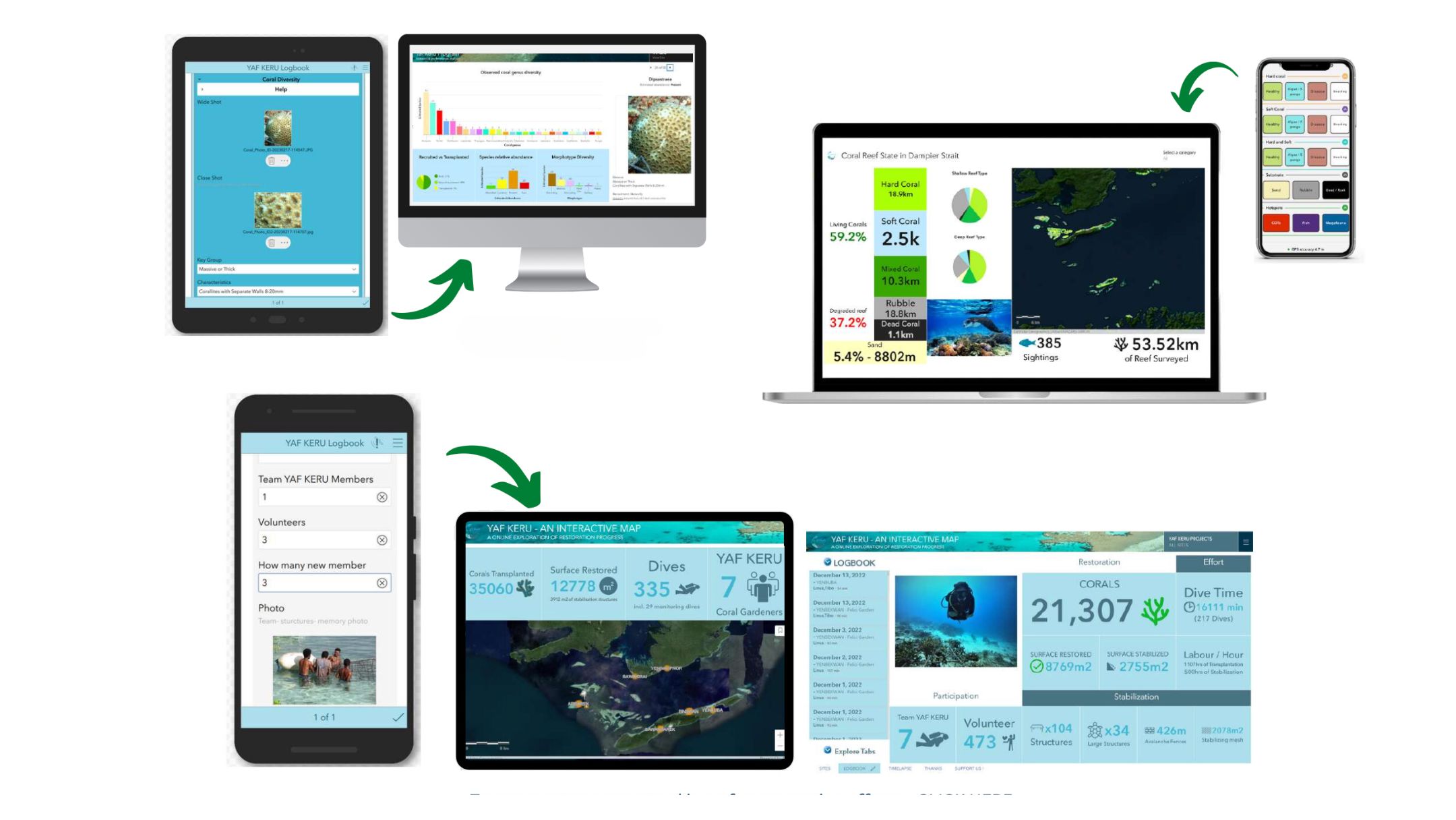
To overcome these challenges and bridge the gap between field data collection, technical interpretation and stakeholder reporting, in partnership with Esri, we use the state-of-the-art ArcGIS platform to collect, compile, display and share information from all our conservation programs.
Improved Accessability
Using a suite of in-house custom designed and dedicated tools, we simplify access to powerful technology, provide appropriate training to local community members – both of which are essential to overcoming barriers to access, and ensuring comprehensive data collection and improved accessibility and inclusion for remote communities to participate in the data collection process.

Real Time Data Sharing
Using our custom built systems, we turn smartphones into effective multilingual tools for recording observations, taking geo-tagged photos, and uploading data in real-time, (even when offline), which becomes immediately available in interactive dashboards to management, decision makers and partners located offsite, or around the world.
Simple But Powerful
Global Technology for Local Use
By adopting this approach, indigenous community members can collect and contribute valid scientific data to program impact assessments and conservation knowledge. By equipping local communities with user-friendly data collection tools, we empower them to participate actively in monitoring, evaluating and protecting their environment. This inclusive approach not only enriches the data pool over the long term, but also fosters a sense of ownership and stewardship among indigenous populations, and reduces reliance upon resource intensive ‘helicopter’ science and research.
The flexibility and integration offered by ArcGIS and other conservation technologies are vital in supporting our projects. These tools not only aid in data collection but also provide real-time insights that help improve decision-making processes. Whether it’s monitoring the health of coral reefs, tracking the impact of tourism, or supporting authorities in enforcing Marine Park regulations, the use of conservation technology ensures that our responses are timely, effective and evidence based, ultimately supporting improved decision making and optimising our conservation output, impact and sustainability.
Through these efforts, we are among the pioneers in effectively implementing conservation technology to enhance environmental management and ensure the sustainable future of Raja Ampat’s unique marine ecosystems.
100% of your donation goes to
the field.
If left unchecked, 90% of coral reefs will be threatened by 2030, with almost all reefs facing, high, very high, or critical threat levels by 2050.
If we don’t act now, future generations will not have the privilege of seeing a live coral reef, let alone receive the benefits that coral reefs provide, including food, coastal protection, livelihoods and medicine.
In Raja Ampat, Indonesia, the most biodiverse coral reefs on Earth are under threat; rapid and unsustainable development combined with climate change threaten the future of these reefs, along with the food security, heritage and livelihoods of many.
Your contribution today has a direct impact in enabling our team to work with local people to Restore, Protect and Conserve reefs in the world’s last remaining coral stronghold.
We cannot do it alone, but with your contribution we can do it together.
100% of your donation goes to
the field.
If left unchecked, 90% of coral reefs will be threatened by 2030, with almost all reefs facing, high, very high, or critical threat levels by 2050.
If we don’t act now, future generations will not have the privilege of seeing a live coral reef, let alone receive the benefits that coral reefs provide, including food, coastal protection, livelihoods and medicine.
In Raja Ampat, Indonesia, the most biodiverse coral reefs on Earth are under threat; rapid and unsustainable development combined with climate change threaten the future of these reefs, along with the food security, heritage and livelihoods of many.
Your contribution today has a direct impact in enabling our team to work with local people to Restore, Protect and Conserve reefs in the world’s last remaining coral stronghold.
We cannot do it alone, but with your contribution we can do it together.
Copyright © The SEA People 2016-2026. All rights reserved. This website is copyright monitored and protected.
Yayasan Orang Laut Papua is a registered NGO under the Ministry of Law and Human Rights Republic of Indonesia. Number AHU-0016408. Year 2019. The SEA People is a registered Charitable Association under the Gouvernement de la République in France (Numero Identification Siren 853074300) and serves as an administrative and fundrasing base for supporting the fieldwork of Yaysan Orang Laut Papua. Privacy Policy Terms & Conditions