For millions of years, long before humans existed, the coral reefs of Raja Ampat withstood the elements and survived. Likely thriving in a largely undisturbed state, these reefs provided shelter and sanctuary to an astonishing array of marine life and laid the foundation for what is today the most biodiverse ecosystem on our planet. Several thousand years ago, these reefs began to support a new species, Homo sapiens, who benefited greatly from the abundance of food, protection and shelter provided freely by this astonishing ecosystem.
Today, the descendants of these first people, now residing in numerous small villages across the regency, continue to rely on, and be safeguarded by the local reefs which now also support healthy local, national and international tourism and fishing industries.
reefs at risk
Why We Need Reef Restoration
THE SCALE OF THE PROBLEM & THE AVALANCHE PHENOMENON
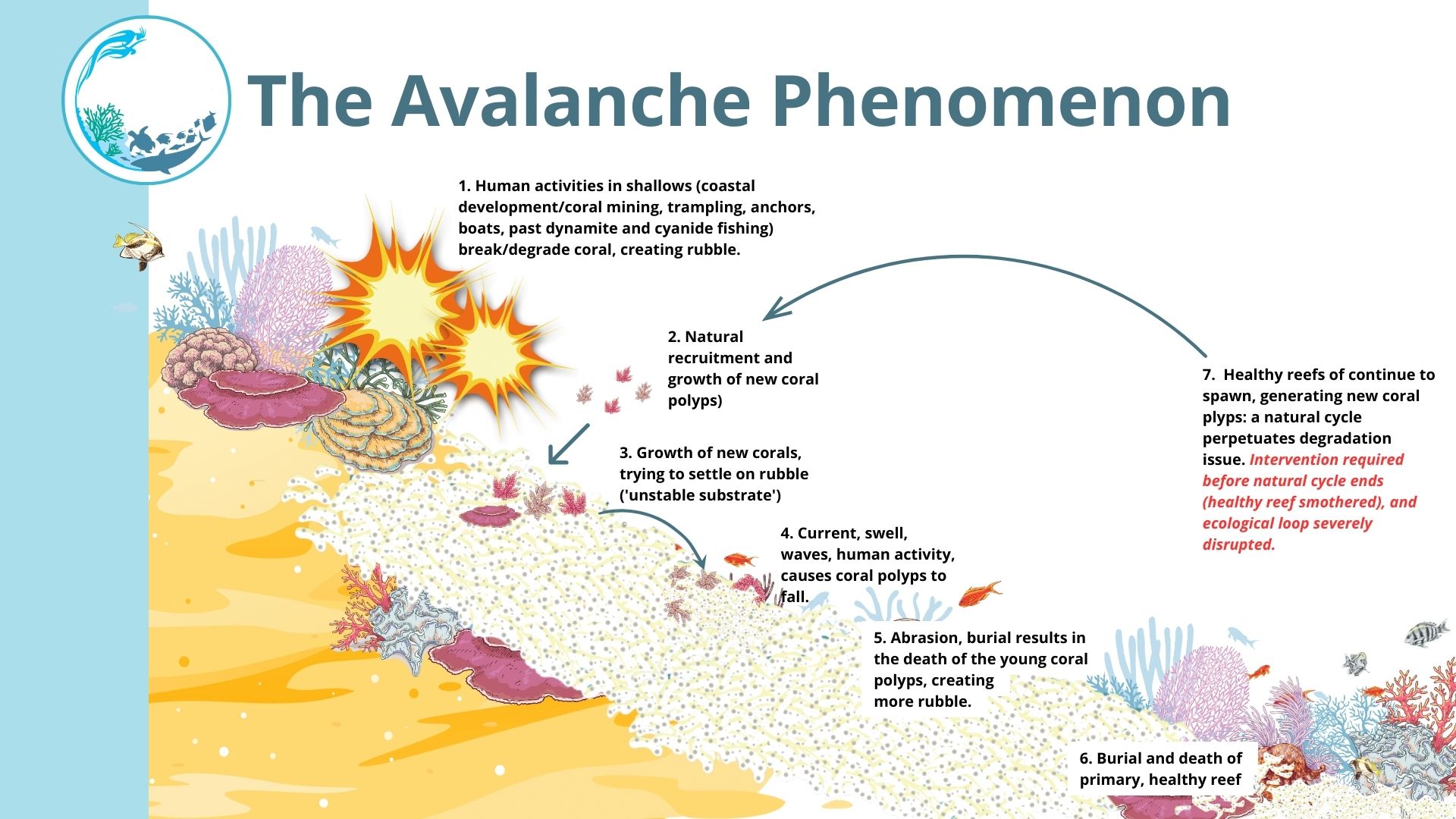
Whilst so much of Raja Ampat remains relatively pristine, amongst the abundance lies the effect of human interference and influence; including large areas of degraded reef and coral rubble. To this day, many of these destroyed reefs have not recovered or regenerated, and cannot do so without assistance. Additionally these degraded areas pose threats to healthy reefs located nearby through an avalanche phenomenon. We have identified 13 hectares of degraded reef in the Dampier Strait alone that require restoration.
THE SCALE OF THE SOLUTION
This short film, by Corinne Bourbeillon, was captured in September 2023 and showcases the scale of the Yaf Keru effort—something we had previously struggled to convey through imagery. At the time of filming, just over 1.4 hectares of degraded reef had been restored, a portion of which is shown in this film. Since then, Yaf Keru has expanded, and continues to grow in scale and impact. Please visit our Impact Map here for transparent, and up to date information regarding our impact.
In many ways Raja Ampat can (and should) be celebrated as a modern conservation success story. Over the past two decades, collaborations between governments, local communities, and NGOs have established a significant MPA network covering nearly a third of the archipelago, largely eradicating practices like dynamite fishing, industrial shark finning, and coral mining.
However, beyond the common narrative of “pristine untouched reefs”, large areas of degraded reef remain – destroyed by past human activities such as cyanide fishing, dynamite fishing, and village construction. Today, rapid tourism growth and coastal development add new challenges, while complex socio-economic conditions further pressure the marine environment. These combined threats hinder natural recovery, endangering both reef ecosystems and the communities that rely on them.
Yaf Keru (which means ‘Coral Garden’ in a local dialect), launched in 2016, is a community-based reef restoration and conservation program in Raja Ampat, the world’s most biodiverse marine region. With and by local people, the program aims to Restore, Protect and Conserve local ecosystems while benefiting indigenous communities and stakeholders. To date, Yaf Keru has transplanted over 65,000 coral fragments, restored over 1.7 hectares of degraded reef, safeguarded an equivalent area of healthy reef, and provided training and employment for local community members through a collaborative, multi-disciplinary approach.
YAF KERU: FOR THE REEF, FOR THE COMMUNITY, FOR THE WORLD
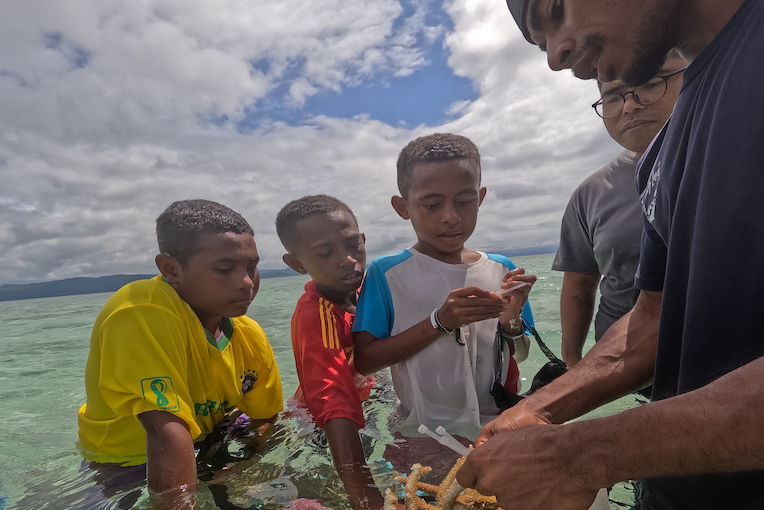
Whilst reef restoration can have a significant ecological output, it also provides both a socio-economic and socio-cultural lift to local community. Yaf Keru is so much more than simply an exercise in “transplanting coral”, but a means to improve several fundamental aspects of people’s livelihoods through education, training and stable/safe employment, which in turn can contribute to improved sustainability, management and conservation.
Since inception, the Yaf Keru Reef Restoration and Conservation Program has integrated community engagement and socioeconomic development into its core operations. Where the conservation and restoration effort is conducted by, and with, local communities, we ensure that conservation efforts are grounded in local knowledge and directly benefit those who are most affected by environmental changes. Through this successful integration of ecological management with socio-economic uplift, we create a powerful model for sustainability that can be replicated across global coastal systems.
So far, Yaf Keru’s impact showcases a scalable and effective Nature Based Solutions approach, and demonstrates how collaborative, community-based conservation efforts can lead to meaningful ecological and socio-economic outcomes.
YAF KERU: THE SCIENCE
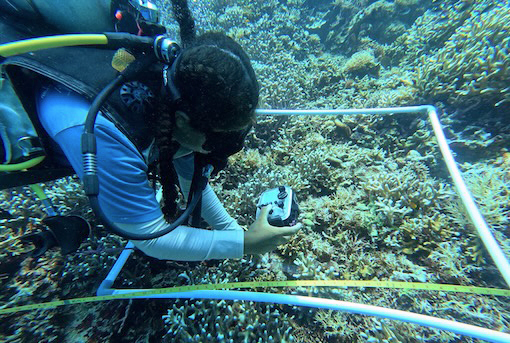
In order to optimise Yaf Keru, and increase impact and likelihood of success, our program is founded on a framework of applied science that underpins restoration techniques, site selection processes, and transplantation methodologies. The program selects restoration sites based on ecological value, anthropogenic pressures dynamics and socio-economic criteria, including biodiversity uplift potential, and resilience to climate change impacts. The transplantation process is guided by both scientific principles and empiricism, utilising best practices in coral restoration to ensure high survival rates of transplanted coral fragments.
This methodological approach not only
aids in the recovery of degraded reefs but also enhances biodiversity (avoiding biodiversity loss) by protecting primary, healthy coral reefs from an avalanche of coral rubble, which in turn supports an abundance of marine life. Additionally, the ecological benefits of the restored reefs extend beyond biodiversity enhancement; they include improved ecosystem services such as coastal protection, fisheries support, and economic attractivity (through tourism, blue finance, and philanthropy), contributing locally to socio-economic climate resilience.
Through scientifically grounded practices, to date Yaf Keru makes a substantial contribution to the field of sustainability science, demonstrating how targeted restoration efforts can restore degraded
coral ecosystems, protect and enhance biodiversity, and strengthen the ecological integrity of ocean and coastal systems against the backdrop of global climate change.
HONEST REPORTING, TRANSPARENT RESULTS
Our Impact:
At The SEA People, we believe in honesty and transparency. We believe in sharing with our supporters the true nature of our reef restoration work; in terms of scale and impact, success, and yes…. the times when things didn’t quite go to plan.
Explore our interactive Impact Map, where our Yaf Keru efforts are documented after each dive, telling (amongst other things) the true story of a reef restoration program over time.
This interactive map is our way to share with you what’s really going on with Yaf Keru – no greenwash, no inflated numbers, just results. Click Here to view.
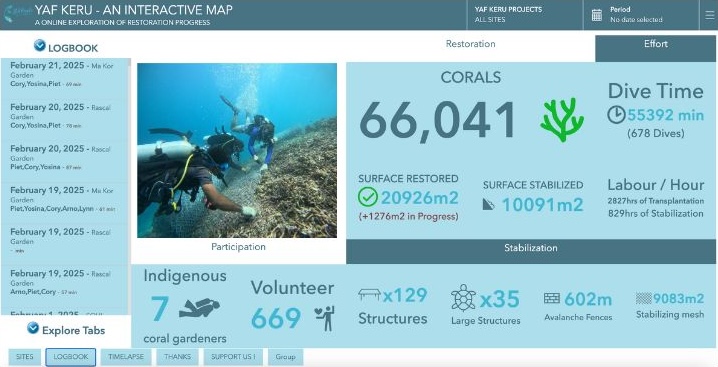
Upated after each dive (restoration or monitoring) our interactive Impact Map shows real time, transparent results.
REEF RESTORATION
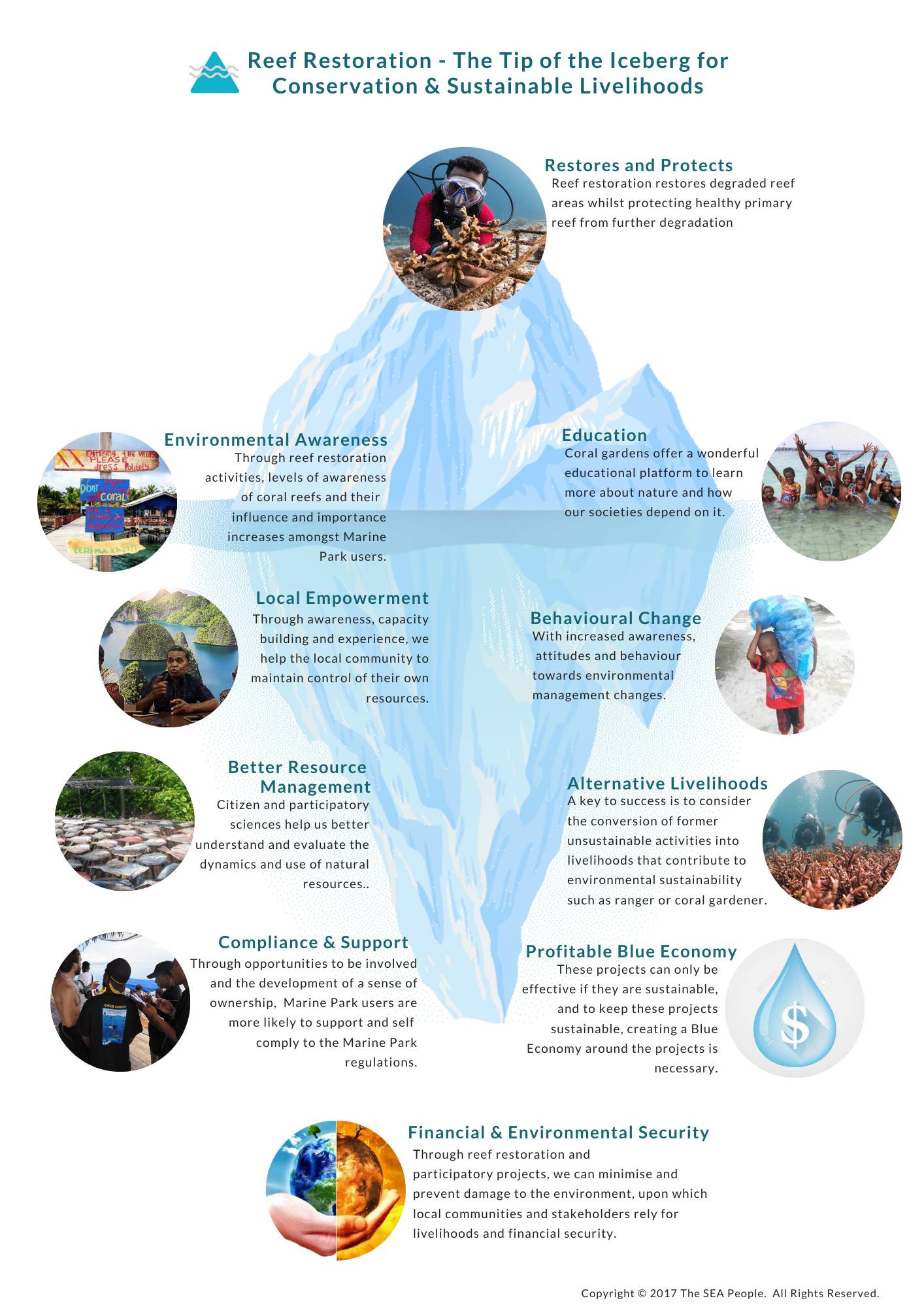
The Tip of the Iceberg
Reef restoration is a critical and visible part of marine conservation, but it represents only the tip of the iceberg—a small but essential piece of a much larger and more complex effort. Beneath the surface, Yaf Keru is about far more than just planting corals; it is about restoring entire ecosystems, strengthening communities, and creating long-term resilience for Raja Ampat’s reefs and the people who depend on them.
At its core, Yaf Keru is a community-driven conservation initiative. Every coral fragment planted is part of a bigger story—one that includes supporting local livelihoods, enhancing marine biodiversity, mitigating climate impacts, and empowering local Papuan communities to become stewards of their own reefs. Restoration is not just about repairing damage; it is about creating a future where marine ecosystems can thrive, where sustainable tourism is balanced with conservation, and where the people of Raja Ampat are equipped with the tools and knowledge to protect their marine heritage for generations to come.
Much like an iceberg, what is visible is only a fraction of the true scale of Yaf Keru’s impact. The deeper significance lies in its ability to drive ecological recovery, sustainable livelihoods, and long-term conservation strategies—ensuring that Raja Ampat remains one of the most biodiverse and resilient marine ecosystems on the planet.
Click Here to englarge image
HELP US REBUILD REEFS, ONE FRAGMENT AT A TIME
Join Us For A Day Of Reef Restoration:
Visiting Raja Ampat to exploring the stunning marine landscapes comes with a hidden cost: the environmental footprint left behind by travel, from carbon emissions to local ecological impacts such as pollution and waste. Recognizing this, we invite you to transform your visit into a meaningful journey of restoration and giving forward. Instead of merely trying to compensate for the impacts made, we encourage a more proactive approach to conservation that has a lasting impact beyond the duration of your stay.
Click Here and found out how you can spend the day with our reef restoration team.
100% of your donation goes to
the field.
For every €20 received, we can restore and protect 1m² of coral reef in Raja Ampat, safeguard 1m² of thriving primary reef, and support local community livelihoods through training, employment, and capacity building.
If left unchecked, 90% of coral reefs will be threatened by 2030, with almost all reefs facing, high, very high, or critical threat levels by 2050.
If we don’t act now, future generations will not have the privilege of seeing a live coral reef, let alone receive the benefits that coral reefs provide, including food, coastal protection, livelihoods and medicine.
In Raja Ampat, Indonesia, the most biodiverse coral reefs on Earth are under threat; rapid and unsustainable development combined with climate change threaten the future of these reefs, along with the food security, heritage and livelihoods of many.
Your contribution today has a direct impact in enabling our team to work with local people to Restore, Protect and Conserve reefs in the world’s last remaining coral stronghold.
We cannot do it alone, but with your contribution we can do it together.
100% of your donation goes to
the field.
For every €20 received, we can restore and protect 1m² of coral reef in Raja Ampat, safeguard 1m² of thriving primary reef, and support local community livelihoods through training, employment, and capacity building.
If left unchecked, 90% of coral reefs will be threatened by 2030, with almost all reefs facing, high, very high, or critical threat levels by 2050.
If we don’t act now, future generations will not have the privilege of seeing a live coral reef, let alone receive the benefits that coral reefs provide, including food, coastal protection, livelihoods and medicine.
In Raja Ampat, Indonesia, the most biodiverse coral reefs on Earth are under threat; rapid and unsustainable development combined with climate change threaten the future of these reefs, along with the food security, heritage and livelihoods of many.
Your contribution today has a direct impact in enabling our team to work with local people to Restore, Protect and Conserve reefs in the world’s last remaining coral stronghold.
We cannot do it alone, but with your contribution we can do it together.
Copyright © The SEA People 2016-2026. All rights reserved. This website is copyright monitored and protected.
Yayasan Orang Laut Papua is a registered NGO under the Ministry of Law and Human Rights Republic of Indonesia. Number AHU-0016408. Year 2019. The SEA People is a registered Charitable Association under the Gouvernement de la République in France (Numero Identification Siren 853074300) and serves as an administrative and fundrasing base for supporting the fieldwork of Yaysan Orang Laut Papua. Privacy Policy Terms & Conditions